

Automotive Engine Market to Reach USD 114.40 Billion by 2035, Growing at 2.56% CAGR
Automotive Engine Market
Asia-Pacific secured 41.4% of Automotive Engine Market volume share in 2025, led by China, India, and Japan.
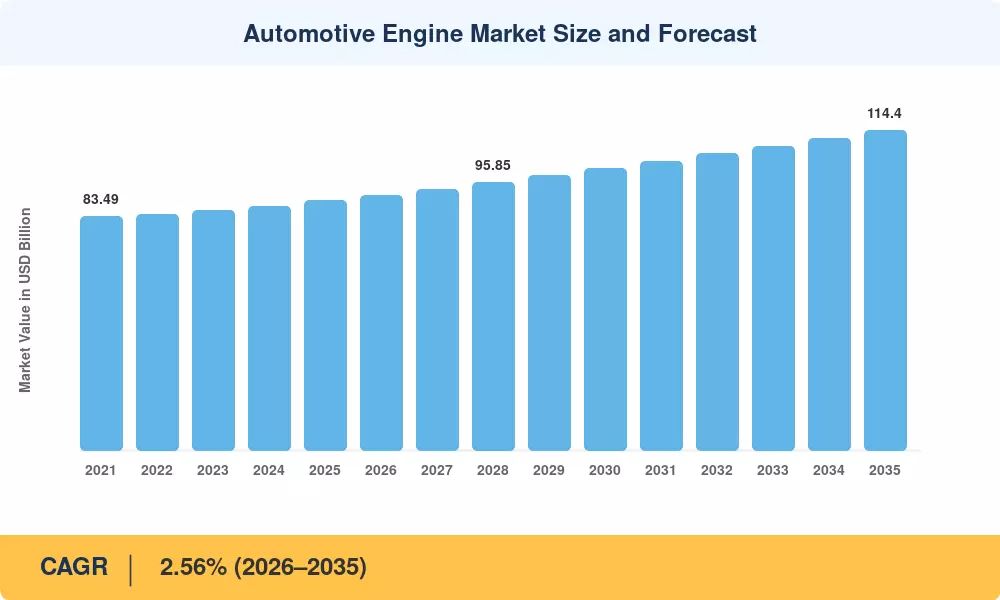
NEW YORK, NY, UNITED STATES, September 3, 2026 /EINPresswire.com/ -- According to Market Research Future, the Automotive Engine Market is projected to grow from USD 91.13 billion in 2026 to USD 114.40 billion by 2035, registering a CAGR of 2.56% during the forecast period, driven by Integration of advanced electric powertrains. This steady growth reflects the ongoing evolution of automotive propulsion, where internal combustion engines continue to play a critical role across global vehicle fleets while adapting to increasing electrification, stricter emission regulations, and shifting consumer preferences toward hybrids and fuel-efficient technologies.Market Overview
Automotive engines are the core propulsion systems in vehicles, converting fuel into mechanical energy to power mobility across passenger cars, light commercial vehicles, and medium and heavy commercial vehicles. The market encompasses diverse engine configurations including in-line, V-type, W-type, boxer/flat, and opposed-piston layouts, serving gasoline, diesel, hybrid-ICE, and alternative fuel applications. As the automotive industry undergoes a historic transformation, engine technology is evolving through hybridization, turbocharging, direct fuel injection, variable valve timing, and lightweight materials to meet modern performance and efficiency demands . The Internal Combustion Engine Market continues to demonstrate resilience, with the automotive segment expected to lead the market, contributing 52.13% globally in 2026 . The Automotive Engine Management System Market is closely intertwined with engine development, as advanced engine control units and sensors are essential for optimizing performance, fuel efficiency, and emissions compliance across all engine types .
The key growth drivers propelling this market expansion include the rising global vehicle production and sales, particularly in emerging economies where growing middle-class populations are driving demand for personal mobility. The increasing adoption of hybrid powertrains is expanding market opportunities for advanced engine technologies that work in tandem with electric motors . Stringent emission regulations, such as Euro 6 and EPA Tier 3 standards, are compelling original equipment manufacturers to develop cleaner, more efficient engine designs and advanced engine management systems . The shift toward SUVs and crossovers, which require more powerful engines to accommodate their size and weight, continues to drive demand for high-performance engine technologies .
Technological developments are reshaping the engine landscape at an accelerating pace. The integration of turbocharging and direct injection technologies is enabling smaller engines to produce more power while consuming less fuel . Lightweight materials such as aluminum and composites are reducing overall engine weight, improving vehicle fuel efficiency and performance . Advanced engine management systems using sensors and software to monitor and adjust engine parameters in real-time are enhancing efficiency and reliability . Cylinder deactivation and start-stop technologies are becoming more common, allowing engines to shut down certain components when not needed, thereby saving fuel and reducing emissions . The development of modular engine architectures is enabling platform sharing across vehicle segments, reducing engineering duplication and shortening time-to-market while preserving differentiation .
Market Segmentation
The automotive engine market is segmented based on placement type, fuel type, vehicle type, and engine capacity to provide comprehensive insights into the industry landscape.
By Placement Type: The market is categorized into In-Line, V-Type, W-Type, Boxer/Flat, and Opposed-Piston engine configurations. In-line engines hold a dominant position due to their simple design, cost-effectiveness, and widespread application across passenger cars and commercial vehicles. The V-Type engine segment is experiencing steady growth, supported by its application in premium vehicles and high-performance applications, with growth estimated at 1.6% CAGR . Opposed-piston engines, while representing a smaller segment, are gaining attention for their potential efficiency advantages in specific commercial applications.
By Fuel Type: The market is segmented into Gasoline, Diesel, Hybrid-ICE, and Other fuel types including CNG, LPG, and H2-ICE. Gasoline engines dominate the passenger car segment, benefiting from the global shift away from diesel in light vehicles following emission scandals and stricter regulations . Diesel engines continue to hold significant share in commercial vehicles and heavy-duty applications where torque and fuel efficiency are paramount. Hybrid-ICE powertrains represent the fastest-growing fuel type segment, driven by the expansion of hybrid and plug-in hybrid electric vehicles that require optimized internal combustion engines to work seamlessly with electric motors . Alternative fuel engines, including CNG, LPG, and hydrogen internal combustion engines, are gaining traction in regions with supportive infrastructure and policy frameworks .
By Vehicle Type: The market serves Passenger Cars, Light Commercial Vehicles, and Medium & Heavy Commercial Vehicles. Passenger cars represent the largest segment, supported by high global production volumes and the expanding vehicle parc across developed and emerging economies . The integration of advanced engine management systems and hybrid technologies is particularly pronounced in the passenger car segment, as automakers strive to meet tightening emission standards and consumer demand for fuel efficiency . Commercial vehicles, encompassing light, medium, and heavy trucks and buses, continue to generate robust demand for durable, high-torque engines capable of supporting logistics, construction, and public transport applications .
By Engine Capacity: The market covers Below 1.5 L, 1.5–3 L, and Over 3 L engine capacity segments. The 1.5–3 L segment dominates the market, offering a balance between performance and efficiency for a wide range of passenger and light commercial vehicle applications. Below 1.5 L engines are prevalent in entry-level vehicles and emerging markets, where affordability and fuel economy are primary considerations. Over 3 L engines are concentrated in premium and performance vehicle segments, as well as heavy-duty commercial applications requiring high power output.
By Region: The market analysis covers North America, Europe, South America, Asia Pacific, and the Middle East and Africa.
🛒 You can buy this market report at:
https://www.marketresearchfuture.com/checkout?currency=one_user-USD&report_id=2166
Regional Analysis
Asia Pacific represents the dominant and fastest-growing regional market, driven by the region's massive automotive production base, rapid urbanization, and escalating demand for transportation . Asia Pacific held 49.95% of the global internal combustion engine market in 2025, reaching a valuation of USD 146.51 billion, and is projected to grow to USD 155.5 billion in 2026 . China, the world's largest automotive market, produced and sold more than 30 million vehicles in 2024, driving massive demand for engine technologies . The country is also exploring ways to preserve internal combustion engines by using substitute fuels such as hydrogen and emerging synthetic fuel engines . India is another key growth market, with expanding passenger vehicle production, rising localization of automotive components, and increasing investments under the Production Linked Incentive scheme. Japan and South Korea drive advanced engine technology development and hybrid powertrain innovation, with Japanese suppliers exporting high-precision engine components globally.
North America represents a mature and strategically important market, with the United States market estimated at USD 26.0 billion in 2025 . The region's robust automobile and aircraft sectors are supporting market growth, with the United States driven by the presence of international players and high-performing engines . The Environmental Protection Agency has announced plans to decrease pollutants from heavy-duty trucks through stricter regulations, pushing developments in internal combustion engines . The shift toward SUVs and pickup trucks generates sustained demand for high-power engines, while aftermarket and commercial vehicle fleets continue to support replacement and maintenance demand. Canada contributes through its integrated automotive supply chain with the United States, with growth forecast at 2.2% CAGR .
Europe represents a significant regional market, shaped by stringent emission regulations, strong automotive engineering heritage, and the accelerating transition to hybrid and electric powertrains. Europe is the fastest-growing region in the internal combustion engine market, driven by rising demand for fuel-based machinery in the industrial sector . Germany, France, Italy, and the United Kingdom are key contributors, with German automakers continuing to lead in premium engine technology and hybrid powertrain development. CO₂ fleet-average targets are driving the adoption of 48V mild-hybrid architecture, a cost-effective compliance pathway that supports advanced engine and starter-generator demand. The European market is increasingly oriented toward hybrid-ICE powertrains as consumers and regulators prioritize emission reduction and fuel efficiency.
South America and the Middle East and Africa represent developing markets with growing potential. In Latin America, Brazil leads through local vehicle assembly, flex-fuel vehicles, and a large replacement market. The Middle East and Africa are gradually adopting advanced engine technologies, supported by improving economic conditions and infrastructure development.
Competitive Landscape and Key Players
The automotive engine market is highly competitive, featuring a mix of global automotive manufacturers, specialized powertrain suppliers, and emerging technology providers. The competitive landscape is characterized by modular platform strategies, strategic partnerships, and aftermarket service expansion .
Key players operating in this market include AB Volvo, Bayerische Motoren Werke AG, Cummins Inc., Ford Motor Company, General Motors Company, Honda Motor Co., Ltd., Hyundai Motor Company, MAHLE Powertrain Ltd, Toyota Industries Corporation, Volkswagen Group, and Yamaha Motor Co., Ltd. . Leading manufacturers have consolidated advantages through modular engine platforms that enable platform sharing across vehicle segments and by expanding service portfolios that include telematics-enabled maintenance agreements .
Strategic developments are reshaping the competitive landscape. Suppliers are investing in advanced combustion technologies, lightweight materials, and integrated thermal management to maintain relevance across multiple powertrain pathways . Collaborative models, including joint ventures and long-term supply agreements, are becoming the norm as firms seek to combine complementary competencies in electrification, fuel systems, and controls . Companies are also investing in calibration expertise and diagnostic tools to capture service revenue as engines remain in operation longer through refurbishment and reconditioning programs .
Innovation and technology initiatives are accelerating across the industry. Firms are investing in modular engine architectures and adaptable control systems to reduce the cost of responding to fuel diversification and region-specific emissions requirements while preserving commonality across vehicle applications . Strategic partnerships between OEMs and fuel-system specialists enable faster adaptation to alternative fuels such as compressed natural gas, liquefied petroleum gas, and hydrogen . The expansion of aftermarket services and refurbishment capabilities is capturing lifecycle revenue as longer service intervals and fuel transitions alter repair patterns .
Latest Industry News and Developments
Recent industry developments highlight the dynamic nature of the automotive engine market. In November 2024, VoltAero, a start-up, announced plans to launch its Cassio hybrid-electric aircraft in the North American market, using a momentum system that combines electric motors for takeoff and short flights with an internal combustion engine for longer trips and battery recharging, demonstrating the continued relevance of internal combustion engines in hybrid applications .
In August 2024, China recorded sales of new energy vehicles exceeding 1 million units for the first time, encompassing both battery electric vehicles and plug-in hybrid electric vehicles, driving demand for hybrid-ICE powertrains that combine advanced internal combustion engines with electric propulsion .
In September 2024, Sensata Technologies introduced a new range of high-precision pressure sensors for automotive use, designed to improve the efficiency of engine management systems by delivering real-time, precise information on engine and environmental conditions .
Market Challenges and Opportunities
The automotive engine market faces several key challenges that could impact growth trajectories. The accelerating transition toward battery electric vehicles is compressing growth potential in the light-duty vehicle segment, as EVs now represent a substantial portion of new vehicle sales in key markets . Stringent emission regulations, including Euro 6, EPA Tier 3, and CAFE standards, require substantial R&D investment and increase development costs . The shift toward hybrid and electric powertrains requires significant retooling and workforce retraining across the engine supply chain. Persistent margin erosion from aggressive pricing strategies and raw material cost volatility continues to pressure profitability for engine manufacturers. Standardization and compatibility issues across vehicle platforms force suppliers to engineer multiple variant configurations rather than benefiting from mass production efficiencies.
Emerging opportunities are abundant in the evolving automotive landscape. The expansion of hybrid powertrains, particularly in Europe and Asia, is creating demand for specialized engines optimized for seamless integration with electric motors . The development of modular engine platforms supporting multiple propulsion types is reducing engineering duplication and enabling faster time-to-market . Alternative fuel engines, including hydrogen internal combustion engines, CNG, and synthetic fuel engines, are gaining traction in regions with supportive infrastructure and policy frameworks . The robust aftermarket, driven by an aging global vehicle parc and rising average vehicle age, continues to support demand for replacement engines and components. Strategic partnerships with fuel-system specialists, telematics providers, and regional suppliers are creating faster pathways to market for alternative-fuel solutions .
To explore more market insights, visit us at:
https://www.marketresearchfuture.com/reports/automotive-engine-market-2166
Final Market Summary
The automotive engine market is positioned for steady growth, driven by hybrid powertrain adoption, the expansion of commercial vehicle fleets, and the continued production of internal combustion engine vehicles across global markets. The market's trajectory from USD 91.13 billion in 2026 to USD 114.40 billion by 2035 reflects the ongoing evolution of engine technology as manufacturers balance performance, efficiency, and sustainability requirements across diverse vehicle segments.
The long-term industry potential remains supported by continued passenger car and commercial vehicle production, the growing hybrid vehicle segment, and advances in engine technology and material science. The convergence of internal combustion engines with broader vehicle electrification, including mild-hybrid and plug-in hybrid systems, is creating opportunities for suppliers that invest in modular, scalable engine platforms and advanced control systems.
Key factors expected to influence future development include the pace of hybrid vehicle adoption, the evolution of emission and fuel-efficiency regulations, and the advancement of alternative fuel technologies. The development of affordable, high-efficiency engines and modular platform architectures will support continued demand across both OEM and aftermarket channels. As vehicles become increasingly connected, electrified, and software-defined, the role of advanced engine systems will continue to evolve, ensuring sustained innovation and growth throughout the forecast period and beyond.
More Related Reports from MRFR Library:
Automotive Torque Converter Market : https://www.marketresearchfuture.com/reports/torque-converter-market-4871
Blind Spot Object Detection System Market : https://www.marketresearchfuture.com/reports/blind-spot-object-detection-system-market-4879
Automotive Timing Belt Market : https://www.marketresearchfuture.com/reports/automotive-timing-belt-market-4929
Automotive Windshield Market : https://www.marketresearchfuture.com/reports/automotive-windshield-market-4956
Automotive Interior Ambient Lighting Market : https://www.marketresearchfuture.com/reports/automotive-interior-ambient-lighting-market-4965
Power Sunroof Market : https://www.marketresearchfuture.com/reports/power-sunroof-market-4972
Drive System Market : https://www.marketresearchfuture.com/reports/drive-system-market-5040
Gasoline Direct Injection Market : https://www.marketresearchfuture.com/reports/gasoline-direct-injection-market-5041
Automotive E Drive Market : https://www.marketresearchfuture.com/reports/edrive-automotive-market-5073
Transmission Repair Market : https://www.marketresearchfuture.com/reports/transmission-repair-market-5078
Market Research Future
Market Research Future
+1 855-661-4441
email us here
Legal Disclaimer:
EIN Presswire provides this news content "as is" without warranty of any kind. We do not accept any responsibility or liability for the accuracy, content, images, videos, licenses, completeness, legality, or reliability of the information contained in this article. If you have any complaints or copyright issues related to this article, kindly contact the author above.
