

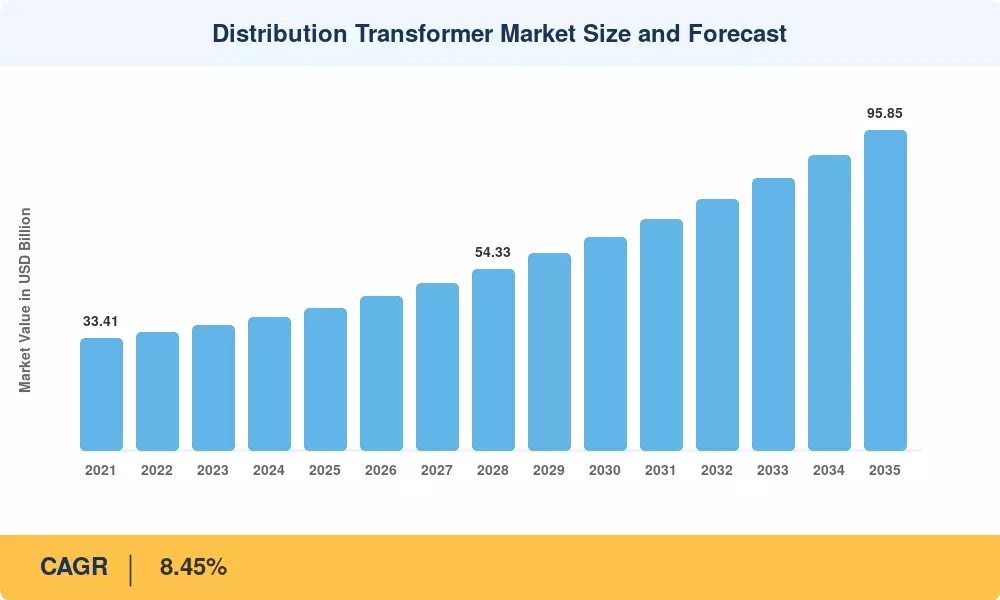
Distribution Transformer Market to Reach USD 95.85 Billion by 2035 at 8.45% CAGR.
Distribution Transformer Industry
Small units (≤ 10 MVA) held a 62.1% revenue share in the Distribution Transformer Market in 2025, reflecting widespread residential and commercial deployment.
Medium units (10–100 MVA) are projected to advance at a 9.2% CAGR through 2035, driven by industrial and renewable-interconnection demand.”
NEW YORK, NY, UNITED STATES, July 29, 2026 /EINPresswire.com/ -- The Distribution Transformer Market reached an estimated USD 42.59 Billion in 2025 and is projected to grow from USD 46.19 Billion in 2026 to USD 95.85 billion by 2035, registering a CAGR of 8.45% during the forecast period.— Prashant Hake
Market Overview
Distribution transformers are critical electrical devices that step down high-voltage electricity from transmission lines to lower voltages suitable for residential, commercial, and industrial consumption. These units form the backbone of last-mile electricity delivery, serving every type of load from homes and businesses to data centers and industrial facilities. Available in various configurations including pole-mounted, pad-mounted, and underground/compact designs, distribution transformers typically range from small units below 10 MVA to medium (10–100 MVA) and large (>100 MVA) variants. Oil-cooled (liquid-immersed) designs dominate the market due to their cost advantages and superior heat dissipation, while air-cooled dry-type units are gaining share in fire-sensitive and indoor installations.
Growth Drivers
The market's robust growth is anchored in several converging forces. Aging grid infrastructure represents a primary driver, with approximately 55% of in-service distribution transformers in developed economies exceeding 33 years of service life. Utilities such as Duke Energy and National Grid have earmarked multibillion-dollar infrastructure replacement budgets through 2030, directly benefiting the market. The U.S. Department of Energy projects that distribution transformer capacity must scale 160–260% by 2050 to sustain electrification targets.
Renewable energy interconnection creates sustained demand, as every solar farm or wind park requires step-down transformation at the distribution level. India's 500 GW non-fossil capacity goal by 2030 alone requires tens of thousands of new distribution transformers for feeder-level voltage management. Data center expansion and EV charging infrastructure are emerging as major catalysts; BloombergNEF estimates U.S. data-center electricity consumption could double by 2030, with each campus-scale facility requiring dedicated transformer banks.
Industry Trends & Technological Developments
A generational technology shift is underway as utilities progressively retire legacy mineral-oil units in favor of ester-fluid and dry-type platforms meeting tightening eco-design regulations. Smart transformers with embedded IoT sensors for dissolved-gas analysis, thermal imaging, and load profiling are transforming distribution assets into data-generating nodes, with utilities piloting digital-twin platforms reporting 15–20% reductions in unplanned outage costs. Amorphous metal cores, which reduce no-load losses by 60–70% compared with conventional CRGO cores, are gaining adoption in loss-sensitive grids. The shift toward natural and synthetic ester fluids, offering higher biodegradability and fire points, is creating a premium-priced segment for early R&D investors.
Policy & Regulatory Influence
Regulatory frameworks play a pivotal role in shaping the market. The U.S. Department of Energy finalized updated energy-conservation standards for liquid-immersed and dry-type distribution transformers in April 2024, effective January 2027, mandating 10–15% reductions in no-load losses. The EU's Eco-design Directive Lot 2 (Tier 2 effective 2027) mandates maximum no-load and load losses for new units, driving adoption of advanced core materials. The U.S. Inflation Reduction Act and Bipartisan Infrastructure Law have channeled billions toward grid modernization, while India's Revamped Distribution Sector Scheme (RDSS), backed by INR 3.04 trillion in central and state funding, targets loss reduction across all states. Federal incentives and domestic-content rules are further reinforcing local manufacturing projects, pushing a multi-billion-dollar investment wave through 2030.
Demand Outlook
The demand outlook remains structurally positive as electrification demand, decarbonization policy, and infrastructure renewal converge globally. Asia-Pacific commands roughly 45.5% of the market, anchored by multiyear utility tenders in China and India. Europe holds 22.0% driven by grid resilience mandates and offshore wind integration, while North America (18.5%) leads in data-center load growth and EV-charging corridor buildout.
Get Free Sample Report for Detailed Market Insights:
https://www.marketresearchfuture.com/sample_request/2581
Market Segmentation
The Distribution Transformer Market is comprehensively segmented to capture diverse industry dynamics and application requirements.
By Power Rating
Small (≤ 10 MVA): Held a 62.1% revenue share in 2025, reflecting widespread residential and commercial deployment. Medium (10–100 MVA): Projected to advance at a 9.2% CAGR through 2035, driven by industrial and renewable-interconnection demand. Large (> 100 MVA): Niche but high-value segment serving heavy industry and primary substations.
By Cooling Type
Oil-Cooled (Liquid-Immersed): Captured 68.5% of 2025 revenue, supported by cost advantages in rural and industrial applications; U.S. market share is approximately 80.9%. Air-Cooled (Dry-Type): Forecast to grow at a 9.5% CAGR through 2035 as fire-safety and indoor-installation requirements expand.
By Phase
Three-Phase Transformers: Accounted for 76.2% of unit volume in 2025, dominating utility and industrial procurement. Single-Phase Units: Expected to register a 9.4% CAGR through 2035, boosted by last-mile rural electrification programs.
By End-User
Power Utilities: Represented 52.1% of market demand in 2025. Residential Applications: Fastest-growing segment at 9.7% CAGR, driven by housing growth and EV home charging. Industrial: Expanding at 8.7% CAGR, with demand from manufacturing, mining, and process industries. Commercial: Valued at USD 6.39 billion in 2025.
You can buy this market report at:
https://www.marketresearchfuture.com/checkout?currency=one_user-USD&report_id=2581
Regional Analysis
North America
North America, contributing 18.5% of the global market, is buoyed by the Bipartisan Infrastructure Law's USD 65 billion allocation for power infrastructure. The U.S. accounts for 72.4% of regional share, driven by grid replacement, the NEVI program for EV charging (USD 7.5 billion), and data-center load growth. The U.S. distribution transformer market is projected to grow from USD 3.41 billion in 2025 to USD 5.60 billion by 2031 at an 8.76% CAGR. Canada's demand is anchored by hydro-dominated provincial grids modernizing aging feeder networks, while Mexico benefits from nearshoring-driven industrial load growth. Persistent supply shortages and lead times of 40–60 weeks are prompting utilities to front-load purchasing.
Europe
Europe holds 22.0% of the market, with demand shaped heavily by the EU's Eco-design Directive and REPowerEU framework. Germany's Energiewende creates acute need for distribution-level capacity at solar and wind connection points, while the UK's offshore wind expansion requires coastal substations with salt-spray-rated equipment. Germany is forecast to grow at an 8.6% CAGR, followed by the UK at 7.8% and the Nordics at 8.1%. The region's focus on low-noise transformers (below 40 dB) and ester-filled platforms is driving adoption of advanced core designs and vibration-damping technologies. France and Italy contribute significant demand through nuclear fleet support and solar distribution integration respectively.
Asia-Pacific
Asia-Pacific is the largest regional market at 45.5% share and is expected to sustain the fastest regional CAGR through 2035. China, accounting for 38.2% of regional share, issues multiyear framework tenders from State Grid Corporation and China Southern Power Grid covering hundreds of thousands of units annually. India, growing at 9.3% CAGR, benefits from the Revamped Distribution Sector Scheme (RDSS) and PM-KUSUM program, with the country targeting 500 GW non-fossil capacity by 2030. Japan leads in amorphous-core technology adoption, while ASEAN economies add transformer demand through rapid urbanization and manufacturing-base expansion. The region's distributed PV capacity exceeding 400 GW creates substantial management requirements for step-down transformation at the feeder level.
Rest of the World
South America and the Middle East & Africa together account for approximately 14% of the market. Brazil dominates South America with 58.5% of regional share, driven by urban distribution upgrades and agribusiness loads. Saudi Arabia's NEOM megaproject and other Vision 2030 initiatives specify desert-rated equipment, creating niche procurement opportunities. South Africa's Eskom rehabilitation program and Egypt's New Administrative Capital infrastructure drive African demand, while sub-Saharan grid-access initiatives backed by the World Bank add volume demand for cost-optimized single-phase units.
Competitive Landscape / Key Players
The Distribution Transformer Market exhibits moderate concentration, with the top five players accounting for an estimated 35–42% of global revenue. Barriers to entry remain significant due to capital intensity, long utility qualification cycles, and supply-chain constraints for grain-oriented electrical steel.
Key Companies
Hitachi Energy (Switzerland): Global full-portfolio leader with digital monitoring and EcoDesign ester-fluid transformers.
Siemens Energy (Germany): European technology leader, pioneer in green transformer initiatives with 100% ester-fluid commitment by 2028.
Schneider Electric (France): Solutions-integrated approach with strong commercial segment presence.
Eaton Corporation (Ireland): North American distribution-utility specialist with Green Motion transformer series.
GE Vernova (US): Americas-focused with Prolec GE range and Mexico manufacturing hub.
TBEA Co. (China): Chinese market leader and Belt and Road exporter.
CG Power & Industrial Solutions (India): India-centric with growing export footprint and amorphous-core licensing.
Toshiba Energy Systems & Solutions (Japan): Pioneer in amorphous-core technology.
Howard Industries and ERMCO (US): Key North American-owned players expanding capacity through domestic investments.
Strategic Developments
Recent strategic movements include major capacity expansions to address supply shortages and DOE efficiency timelines. Hitachi Energy has announced investments expanding transformer production across multiple U.S. sites. Eaton doubled output in Texas through a major manufacturing expansion completed in 2025. GE Vernova announced plans to acquire the remaining stake in Prolec GE to control capacity and lead times. Siemens Energy launched the Green Transformer initiative in June 2024, committing to 100% ester-fluid insulation across its European distribution portfolio by 2028. In August 2023, CG Power signed a technology licensing agreement with Hitachi Energy to manufacture amorphous-core transformers in India.
Latest Industry News & Developments
Siemens Energy Green Transformer Initiative (June 2024): Committed to 100% ester-fluid insulation across its European distribution portfolio by 2028, aligning with EU Eco-design Tier 2 requirements.
U.S. DOE Finalizes Updated Efficiency Standards (April 2024): Mandated 10–15% reductions in no-load losses for liquid-immersed and dry-type distribution transformers, effective January 2027.
TBEA Wins State Grid Contract (November 2023): Secured a framework contract valued at over USD 500 million for distribution transformers across seven Chinese provinces through 2026.
Market Challenges & Opportunities
Key Restraints
Volatile Raw Material Prices: Copper and grain-oriented electrical steel together make up 40–50% of the bill of materials; copper exceeded USD 10,000 per tonne in 2024, and GOES remains supply-constrained.
Lead-Time Elongation: Average lead times stretched from 12–16 weeks pre-pandemic to 40–60 weeks by 2024, forcing utilities to front-load purchasing and accept standardized designs.
Skilled-Labor Shortages: Transformer manufacturing relies on specialized winding technicians facing talent gaps in North America and Europe.
Regulatory Fragmentation: Diverging regional standards create compliance complexity for global OEMs.
Emerging Opportunities
Ester-Fluid and Bio-Based Insulation Platforms: The shift from mineral oil to biodegradable ester fluids creates a premium-priced segment, with ester-filled units offering fire-safety comparable to dry-type designs at lower cost.
Smart Transformer Monitoring and Predictive Analytics: Embedded IoT sensors and digital-twin platforms reduce unplanned outage costs, creating recurring-revenue opportunities for OEMs.
Amorphous-Core Adoption in Loss-Sensitive Grids: 60–70% reduction in no-load losses translates to lifetime savings exceeding modest purchase-price premiums.
Emerging-Market Rural Electrification: Sub-Saharan Africa and South Asia represent over 700 million people without reliable grid access, supporting sustained volume growth.
Modular and Pre-Fabricated Substation Designs: On-site installation time reduced by 30–40%, valued by mining, renewable, and data center operators.
To explore more market insights, visit us at:
https://www.marketresearchfuture.com/reports/distribution-transformer-market-2581
Final Market Summary
The Distribution Transformer Market is positioned for sustained and substantial growth, with projections indicating a doubling of market value from USD 42.59 billion in 2025 to USD 95.85 billion by 2035, at a CAGR of 8.45%. This expansion is underpinned by aging grid infrastructure replacement, accelerating renewable energy interconnection, data-center load growth, and EV charging corridor expansion. While challenges including raw material price volatility, lead-time elongation, and skilled-labor shortages persist, emerging opportunities in ester-fluid platforms, smart monitoring, amorphous-core adoption, and emerging-market electrification offer significant potential for industry participants. The future market landscape will be defined by companies that successfully scale domestic manufacturing capacity, navigate regulatory compliance across multiple jurisdictions, and invest in digital and sustainable transformer technologies. Asia-Pacific will continue to drive global growth, while North America and Europe sustain demand through modernization and replacement cycles.
More Related Reports from MRFR Library:
Gas Generator Market: https://www.marketresearchfuture.com/reports/gas-generator-market-4364
Hydropower Market: https://www.marketresearchfuture.com/reports/hydropower-market-4368
Fuel Management System Market: https://www.marketresearchfuture.com/reports/fuel-management-system-market-4394
Circulating Fluid Bed Boilers Market: https://www.marketresearchfuture.com/reports/circulating-fluid-bed-boilers-market-4414
HVDC Converter Station Market: https://www.marketresearchfuture.com/reports/hvdc-converter-station-market-4456
Small Wind Power Market: https://www.marketresearchfuture.com/reports/small-wind-power-market-4568
Medium Voltage Cables Market: https://www.marketresearchfuture.com/reports/medium-voltage-cables-market-4584
Power Battery Management System Market: https://www.marketresearchfuture.com/reports/power-battery-management-system-market-4609
Steam Turbine Market: https://www.marketresearchfuture.com/reports/steam-turbine-market-4618
Hot Water Circulator Pump Market: https://www.marketresearchfuture.com/reports/hot-water-circulator-pump-market-4903
Larry Wilson
WantStats Research And Media Pvt. Ltd.
+1 855-661-4441
email us here
Visit us on social media:
LinkedIn
Facebook
YouTube
X
Legal Disclaimer:
EIN Presswire provides this news content "as is" without warranty of any kind. We do not accept any responsibility or liability for the accuracy, content, images, videos, licenses, completeness, legality, or reliability of the information contained in this article. If you have any complaints or copyright issues related to this article, kindly contact the author above.
